
5.8 KiB
 TwlNandTool
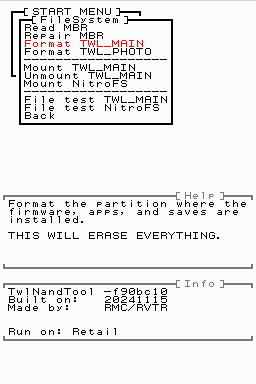
TwlNandTool is the best DSi NAND repair tool out there, offering features such as:
- Fixing MBR
- Formatting FAT partitions
- Recovering deleted HWInfo Secure
- Installing Stage2 (NandFirm)
- Installing new system files
- Installing minimal firmware titles and unlaunch
- Testing firmware and DSiWare for corruption
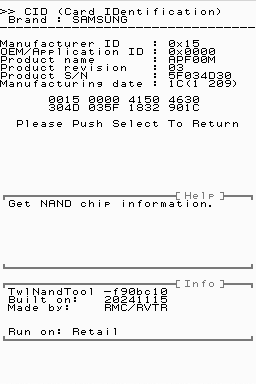
- Lots of useful NAND diagnostic info
- And more documented here!
Why do these matter? No matter how badly messed up your DSi is- even if your NAND is zerofilled- TwlNandTool can put it back in a working state. You don't even need a NAND backup (though it is still HIGHLY RECOMMENDED)! Best of all, it's compatible with retail and development DSis both!
Building
devkitPro decided to release libnds v2.0 and break... everything. Features I need like lower level NAND editing do not seem to work in the new calico, so I'm evily forcing you to use an offensive pre-v2.0 docker image that'll destroy the community or something. I think that's what devkitPro would say. Anyways:
Download the outdated docker image!
docker image pull devkitpro/devkitarm:20241104
Run the outdated docker image!
docker run --rm -v /home/rvtr/Desktop/TwlNandTool:/work \
    -it --entrypoint bash devkitpro/devkitarm:20241104
Running the docker image will open a shell. Simply do this in the shell:
cd work
make
I have made a backup in case the docker image ever gets pulled.
Contributing
I'm basing a lot of this off of my private DSi NAND archive and a lot of DSi factory tools. If you have any of the above, especially a bricked DSi, please contact me. Having these as a reference is extremely helpful for covering more edge cases.
Notes
- I am including my own hostile and outdated fork of libfat (devkitPro's enemy speedrun any %). This is to block
nand_Startup()duringfatMount(). Without this having a NAND re-mount would runnand_Startup()more than once and break every NAND R/W function until reboot... - I do not use the release NandFirm/stage2/bootloader (v2435-8325). Instead I use newer NandFirms as listed below. These NandFirms are able to run unlaunch, however they will stop the installer from working ("unknown bootcode version"). Unlaunch installs carry a brick risk by sometimes erasing the Launcher TMD, so this will somewhat forcefully encourage users to move to a safer installer. Normally I'm against intentionally breaking things but this will prevent future bricks.
- v2265-9336 (prod)
- v2725-9336 (dev)
- My HWInfo Secure recovery works by searching specific locations for HWInfo. As far as I can tell an officially created HWInfo Secure will only start at one of the below 3 offsets. Homebrew (like this tool) will likely create it elsewhere.
0x790000: retail and pandas0x784000: ISTC (needs confirmation) and ISTD0x794000: Happened when I deleted HWInfo and let SystemUpdater create it
- I mention prod and dev a lot. Prod (retail) DSis are the typical ones you would buy in stores. Dev DSis are used by developers for testing, or in factory hardware (I'm excluding IS-TWLs from this description). Prod and dev function the same, but the bootloader, apps/tickets/TMDs, certificates, photos, and HWInfo use different signing and encryption keys. Please keep these differences in mind when making changes to TwlNandTool.
Do you support IS-TWL-DEBUGGER/CAPTUREs?
IS-TWLs are rarer, harder to fix, and have different firmware, so they have been blacklisted from TwlNandTool. However, I'd be happy to personally help you if your IS-TWL has an issue. Please contact me and describe your problem in detail.
Creating AGING tests
AGING mode is used to create an automated set of tests. This can be used to find and fix certain issues without the need for user input. If you want to make an AGING test, just enable agingMode and load all the tests you need like this:
agingMode = true; // disable user input on tests
success = true;
clearScreen(cSUB);
iprintf("\n>> Demo AGING test start        ");
iprintf("\n--------------------------------");

// run all your functions as needed:
if (success && !importNandFirm(false)) {
    success = false;
}
if (success && !readNandFirm()) {
    success = false;
}

agingMode = false; // enable user input on tests
clearScreen(cSUB);
iprintf("\n>> Demo AGING test result       ");
iprintf("\n--------------------------------");
if (success == true) {
	iprintf("\nAll tests passed okay.");
	setBackdropColorSub(0x1FE0); // green background
} else {
	iprintf("\nTests failed!");
	setBackdropColorSub(0x00FF); // red background
}

exitFunction(); // wait for user to confirm the result, then leave the AGING test
You can see a larger example AGING with debug3() in main.c
Including system files
B-b-but you have system files like the bootloader! These files are required to boot a DSi and almost always cannot be custom made due to signing. This is a tool meant to fix every possible software brick, and to do so in an accessible way. Most people are not going to know how to recover a bootloader, find the right FontTable for their region, or get the correct and safe wlanfirm/sysmenuVersion. Even given a well written guide, I know the "what's a hex editor" or "what's a byte" messages all too well. It is not safe to force people to chase after things they may not understand. Especially when one wrong file will cause a brick, and the owner will be none the wiser.